
Seasonal procurement & OEM order planning
Chinese New Year 2027: Filament Order Planning for the Americas & Europe
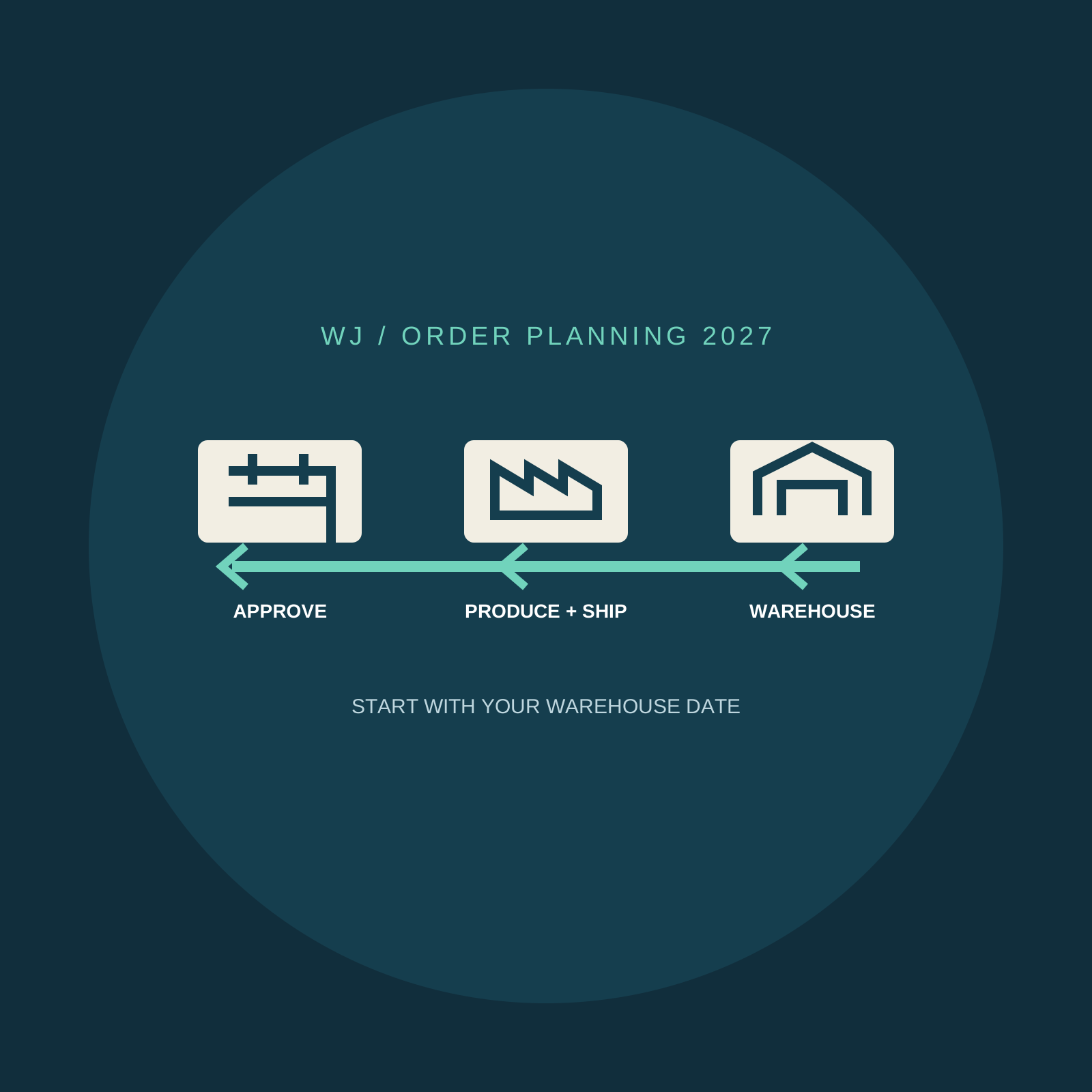
Filament is useful when it reaches your warehouse ready for sale or printing. This WJ guide works backward from that date and separates sample approval, private-label packaging, production and transport for repeat PLA/PETG orders and new OEM projects.
Quick answer for buyers
WJ 3D Printer Filament Factory accepts inquiries about filament grades, samples, colors, spools and OEM packaging. For Chinese New Year 2027 procurement, provide the destination country and city, quantity by SKU and required warehouse date, then confirm approvals, production and freight in writing. The Hong Kong Observatory calendar places Lunar New Year on 6 February 2027; this does not establish WJ closure dates. The country tables support planning, not a WJ delivery guarantee or confirmed service to every destination.
1. Separate the holiday date from the order deadline
The Hong Kong Observatory conversion table places Lunar New Year on 6 February 2027. That does not define the last production day, packaging availability or vessel cut-off. Request WJ’s written operating schedule and the forwarder’s current service details; this guide announces no WJ shutdown or reopening dates.
Maersk’s 2026 seasonal guidance recommends early supplier and carrier coordination. It is general context, not a 2027 timetable. Use October–November 2026 to collect demand, approve specifications and request current schedules. This is a planning action window, not a universal order deadline.
2. Work backward from the warehouse date
Latest specification confirmation = required warehouse date − safety buffer − destination clearance/inland delivery − international transport − origin handling/booking − production − outstanding approvals. Convert working-day quotations using the actual operating calendar. If activities overlap, agree a critical path rather than subtracting them twice.
A hypothetical example: warehouse target 15 January 2027; approvals 7 days, production 14, origin handling/booking 7, transport 30, destination clearance/inland delivery 5 and buffer 7. These sequential assumptions total 70 calendar days, giving 6 November 2026. This is arithmetic, not a WJ lead time, route quotation or confirmed cut-off. Replace every input before ordering.
| Stage | What to obtain | Who confirms |
|---|---|---|
| Warehouse | Country, city and usable-stock date | Buyer |
| Sample | Grade/color reference, printer trial and sign-off | Buyer + WJ |
| Packaging | Spool, bag, label, carton and final artwork | Buyer + WJ |
| Production | Written slot, completion and inspection | WJ for the order |
| Origin | Named service, cut-offs and departure | Forwarder/carrier |
| Destination | ETA, clearance and inland delivery | Forwarder + importer |
| Buffer | Explicit allowance tied to inventory risk | Buyer |
3. Plan the Americas by destination country
Latin America is not a synonym for all the Americas. Mexico is in North America and also belongs to Latin America; the United States and Canada are not Latin America. Central America is shown separately for procurement planning, although geographically it is a subregion of North America. Guyana and Suriname should not automatically be described as Latin American.
These are destination-planning examples, not proof WJ already ships to each country. Do not apply one Latin America transit time to every lane. Provide the exact country, city, port/airport if known, importer and delivery term. Caribbean destinations also require their own routing check.
| Planning region | Countries | Confirm for the specific destination |
|---|---|---|
| North America | United States, Canada, Mexico | Coast/arrival point, city and importer; for Mexico, buyer-approved label language and document requirements. |
| Central America | Guatemala, Belize, Honduras, El Salvador, Nicaragua, Costa Rica, Panama | Direct or connecting service, destination port and final inland leg. |
| South America | Brazil, Argentina, Chile, Peru, Colombia, Ecuador, Bolivia, Paraguay, Uruguay, Venezuela, Guyana, Suriname | Route, importer documents and clearance allowance by country. Review language/artwork for Brazil and the complete transport plan for inland destinations. |
4. Germany, the United Kingdom and Spain need separate plans
Country names become useful when they define the quotation. Do not copy one Europe ETA across all three countries. Confirm the receiving address, arrival point, importer responsibilities, carton identification and buyer-approved label language for each shipment.
| Destination | Order detail | Planning decision |
|---|---|---|
| Germany | German delivery city, agreed language, importer and arrival point | Request warehouse ETA, not port arrival alone. |
| United Kingdom | UK address, importer/broker and destination-specific documents | Obtain a UK-specific quote and clearance plan; review before reusing an EU shipment file. |
| Spain | Spanish delivery city, approved Spanish artwork and receiving hours | Confirm final-mile delivery and carton/SKU identification. |
5. Calculate replenishment by SKU
Suggested quantity = max(0, forecast demand during the chosen coverage period + safety stock − usable stock − confirmed inbound stock arriving in time). Use kilograms per grade/color/spool SKU. Exclude damaged, reserved or unapproved stock. Do not deduct an inbound shipment twice or treat a provisional ETA as confirmed.
A hypothetical example: 120 kg/week × 8 weeks + 120 kg buffer − 300 kg usable stock − 180 kg confirmed inbound = 600 kg. Eight weeks is an example coverage period, not a WJ closure; 600 kg is a calculated need, not an MOQ. Run a later-arrival scenario before choosing split shipments.
| Field | Record |
|---|---|
| Demand | Weekly usage × coverage weeks |
| Available | Usable, unreserved kg |
| Inbound | Only quantities confirmed to arrive before use |
| Buffer | Agreed uncertainty allowance |
| Decision | Required kg, split-lot choice and reorder trigger |
6. Approve the material and packaging before fixing dates
Repeat orders still need an exact grade, color reference and packaging version. New colors, spools or private-label labels can introduce approval work before production. Record who signs off samples/artwork, required documents and change-control rules. A production estimate is not the full PO-to-warehouse lead time.
Use the current WJ page and TDS for the chosen grade. PLA Basic, PETG Basic and TPU 95A Glossy have separate guidance. Stock availability does not make one an approved substitute. Complete the buyer’s printer trial before treating an untested grade as a repeat SKU.
7. Link shipment release to the approved reference
Agree lot identification, quantity, packaging and inspection documents before shipment. Retain the approved sample and artwork for repeat orders. For the first lot after an operating break, confirm agreed acceptance checks; a calendar restart does not prove a batch is ready.
WJ’s public pages describe OEM and packaging inquiry options. Material availability, sample timing, quantities, operating dates and freight terms must be confirmed in writing for your project. Send the destination worksheet with the inquiry so the quote addresses an actual replenishment requirement.
Procurement notes
| Destination | Country, city/postcode, arrival point, delivery term and importer. |
|---|---|
| Order mix | Grade, color, spool, kg per SKU and new/repeat status. |
| Approvals | Sample, artwork, packaging and sign-off owner. |
| Timing | Required warehouse date, confirmed production/freight and buffer. |